Spedizione gratuita in tutto il mondo

Stars In Hands
33% DI SCONTO SUL PRIMO ORDINE | ACQUISTA ORA →

Il tuo carrello

Nessun prodotto nel carrello.

Behind the Scenes

The Science Behind Our Star Maps: How Custom Celestial Charts Work

A technical deep-dive into how Stars In Hands turns a date, time, and location into an astronomically accurate star chart — catalogs, coordinate systems, and the math behind every print.

14 min read
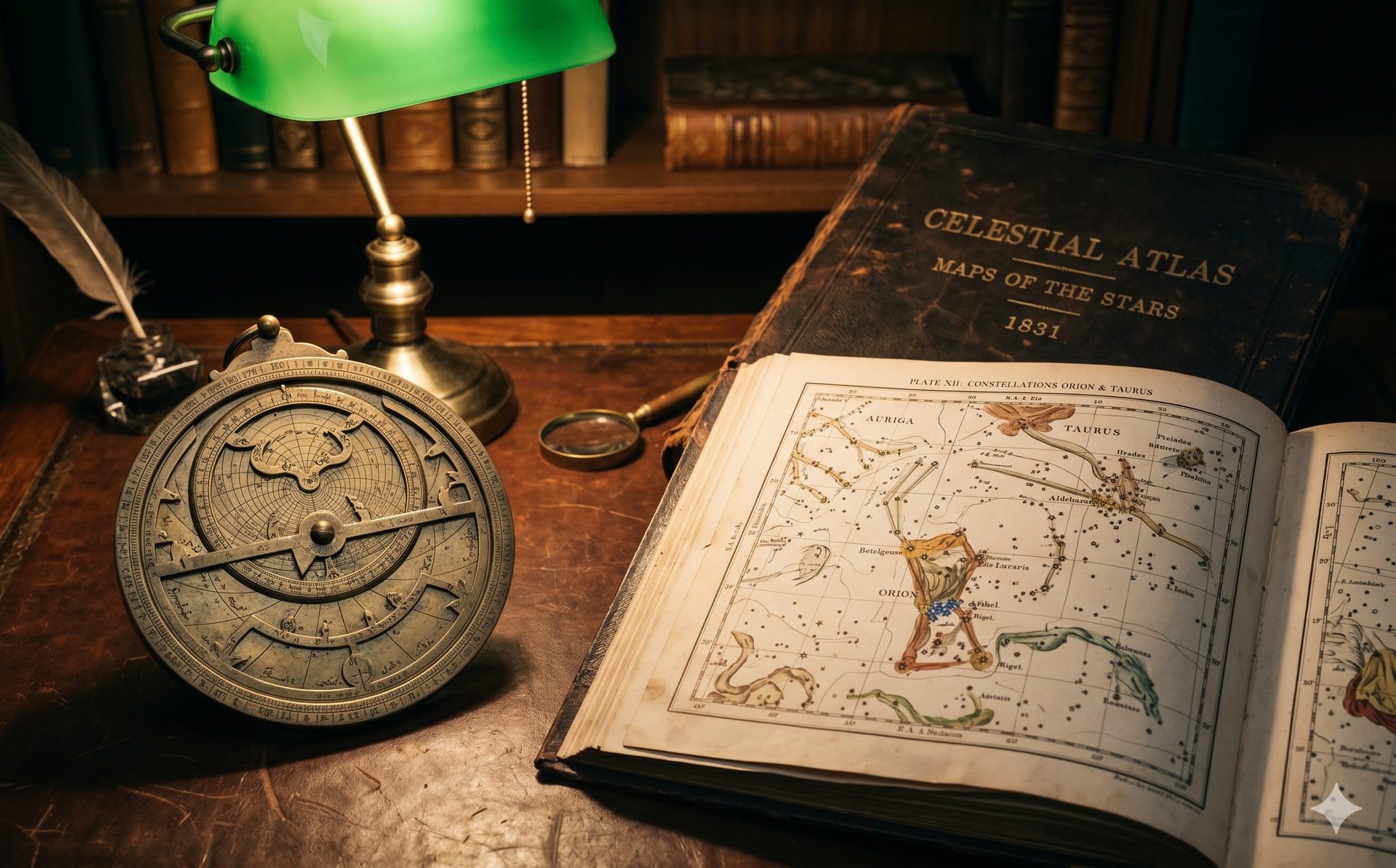
A brass astrolabe beside an open 1891 Celestial Atlas under a green banker's lamp

What "astronomically accurate" actually means

Astronomically accurate means that the star positions on your poster match, to within sub-arcminute precision, what an astronomer would plot for the same date, time, and location using the same data sources professional observatories use.

For practical purposes: if you held a Stars In Hands poster up on the correct night at the correct place, every constellation on the poster would line up with the real sky within the limits of human eye resolution (~1 arcminute).

The "accuracy" claim is worth defining because the custom-poster market is full of designs that are merely evocative — dots scattered on navy, with no relationship to any real sky. Ours are not that.

The star catalog we render from

We render from the Hipparcos and Tycho star catalogs — the same datasets professional observatories use. Between them they cover every star visible to the naked eye from Earth's surface, plus many that aren't.

Hipparcos was compiled by the European Space Agency between 1989 and 1993. It measured the positions of about 118,000 stars to milliarcsecond precision. Tycho adds another 2.5 million fainter stars at slightly lower precision. Together they form the backbone of modern astrometry.

Each star in the catalog has a right ascension and declination — celestial longitude and latitude — plus parallax, proper motion, and magnitude (brightness). From your chosen coordinates and timestamp, we project those onto a flat disk showing the sky overhead at that exact moment.

Fainter stars are included up to a magnitude cutoff that we set based on the poster's display density. Too many stars and the chart becomes a grey smudge. Too few and it looks sparse. The sweet spot for our 30×40cm poster is magnitude 5.5 — about 3,000 visible stars per hemisphere.

Why the same sky looks different at different times

The sky rotates once every 23 hours 56 minutes — a sidereal day, which is 4 minutes shorter than the 24-hour solar day we run our lives on.

That means the sky at 9pm tonight is about 1° different from the sky at 9pm tomorrow, and about 30° different from the sky at 9pm one month later. Over a year the entire constellation cycle completes.

Your chosen date and time pin down exactly which rotation of the sky we draw. Two star maps from the same city on adjacent days will have visibly different constellation positions — sometimes subtle, sometimes dramatic depending on the season.

Local time matters too: 9pm in Paris is 8pm UT, 4pm in New York, and 5am the next day in Tokyo. Our editor takes local time + location and converts internally — you never have to think about UTC.

Coordinate systems — a short refresher

Astronomers use a few overlapping coordinate systems. Understanding them clarifies why your exact lat/lng matters.

Right ascension and declination are the equatorial system — imagine projecting Earth's equator and poles onto the celestial sphere. RA is measured in hours (24-hour day), Dec in degrees (±90°). These coordinates are fixed to the stars, not the Earth.

Altitude and azimuth are the local system — which part of the sky is overhead at your specific location at this specific moment. We convert RA/Dec to alt/az using your latitude, longitude, date, and time. That's what we project onto the flat disk you see on the poster.

How we render the Milky Way band

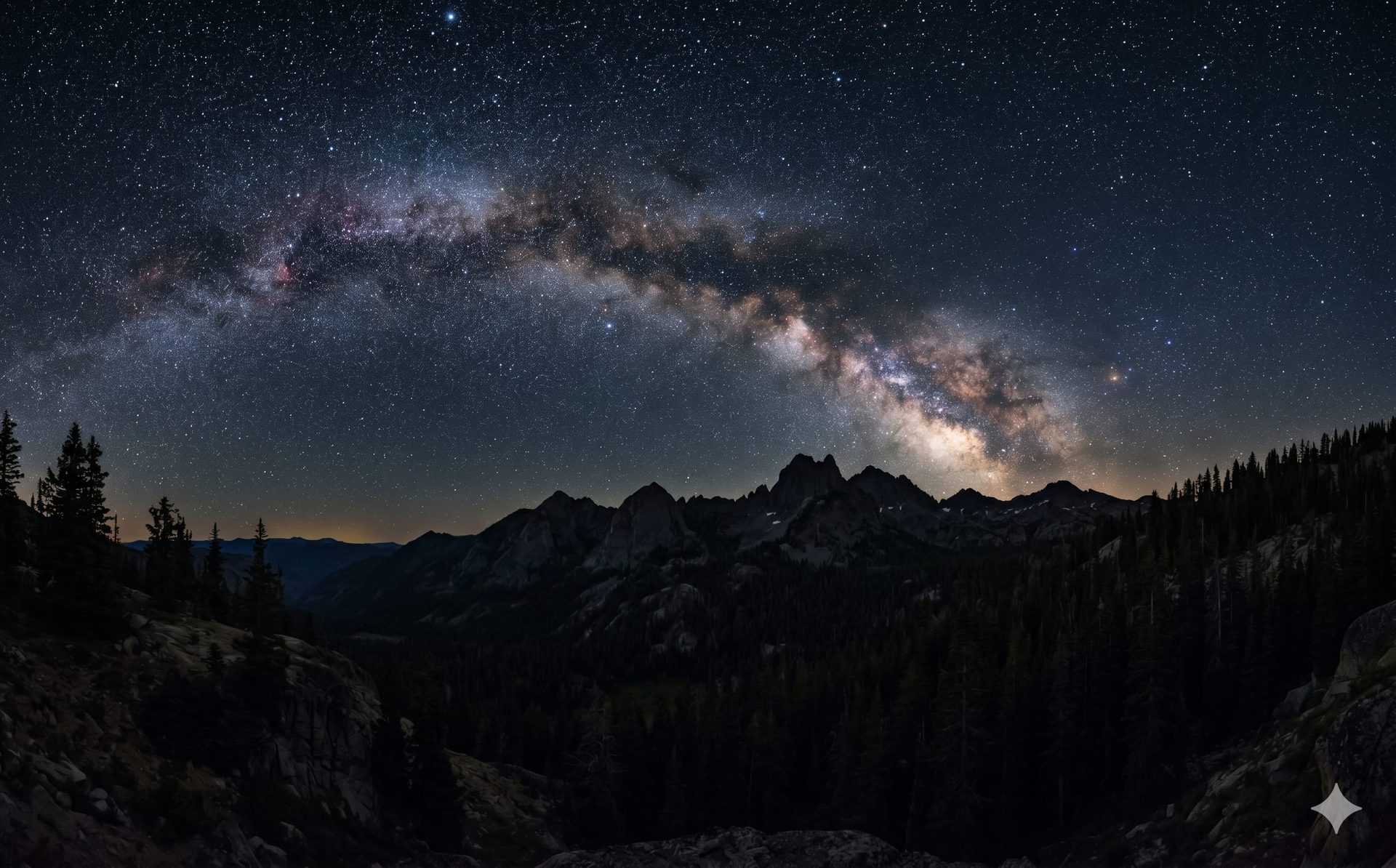
The pale arcing band across many of our charts is the Milky Way — our galaxy viewed edgewise from inside it. Whether it's visible depends on the time of year, your hemisphere, and (in real life) how dark the sky is.

We render it as a translucent gradient derived from the 2MASS infrared survey, which maps the total stellar density of the band across the whole sky. It's accurate down to rough galactic-arm structure — the densest part is toward the galactic center, roughly between Sagittarius and Scorpius.

You can toggle the Milky Way on and off in the editor. Most customers leave it on (it makes the chart feel more "night sky" and less "clinical diagram"). Monochrome designs sometimes look cleaner with it off.

Constellation lines — art meets astronomy

The lines connecting stars into constellations aren't physical. Stars in a constellation are rarely close to each other in space — they're just close on the sky from our angle. The lines are cultural memory, drawn to aid pattern recognition.

We render the International Astronomical Union's standard 88 constellation shapes, the same ones used in every planetarium and astronomy textbook. Each shape is the connect-the-dots line a working astronomer would use to identify the constellation in the field.

A handful of cultures drew different lines on the same stars. Ours are the Western / IAU convention — if you'd like an alternative (Chinese or Polynesian constellation systems, for example), it's a custom order.

Why the moon and planets are drawn separately

The moon and planets move differently from the stars. Stars effectively don't move on human timescales (we correct for proper motion, but it's a sub-arcminute correction over centuries). The moon moves about 13° per day; Jupiter about 1° per week; Mars about 0.5° per week.

We calculate the moon's position, phase, and illumination for your exact date and time using the same VSOP87 algorithms JPL uses for their Horizons ephemeris. The lit fraction is accurate to within 0.1%.

For planets, we show their positions if they were above the horizon at your chosen moment. You can toggle this off if you prefer a pure star chart, and most customers do — but for astronomy-nerd gifts, planetary alignments on a specific date are a genuinely special detail.

How precise is "astronomically accurate"?

Star positions render to sub-arcminute precision — well below the 1-arcminute resolution of the human eye. The time you enter is accurate to the minute; the location accurate to 0.001° of latitude and longitude, which is about 100 meters on the ground.

In practical terms: a star map we print at 8:23pm in Paris vs. 8:24pm in Paris will be imperceptibly different on the page, but provably different in the math underneath. At typical poster viewing distances (1-2 meters), nothing is lost.

The biggest source of error in a printed star map isn't the math — it's whether you remembered the exact date correctly. Double-check the date before you order.

A Stars In Hands poster is a scientifically reproducible snapshot of a moment, not a decorative impression of one.

Domande frequenti

Are Stars In Hands star maps astronomically accurate?

+

Yes. We render from the Hipparcos star catalog (the same dataset professional astronomers use) and project positions from your exact coordinates and timestamp. Star positions are accurate to sub-arcminute precision, well below the resolution of the human eye.

What star catalog does Stars In Hands use?

+

We use the Hipparcos catalog (118,000 stars, measured by the ESA between 1989-1993) plus the Tycho-2 catalog (2.5 million fainter stars). Together these are the standard reference datasets for professional astrometry worldwide.

Does the time of day affect my star map?

+

Significantly. The sky rotates once every sidereal day (23h 56m 4s). A star map at 8pm and a star map at midnight on the same night show entirely different constellations overhead. If your moment has a specific time (a wedding, a birth), include it — it's not a cosmetic field.

What is the Milky Way band on my star map?

+

It's the visible edge of our galaxy — billions of stars blurred together into a pale band across the sky. Whether it appears on a given night depends on the time of year and your latitude. We render it from the 2MASS infrared survey. You can toggle it on/off in the editor.

Why don't some star maps show the moon?

+

The moon is optional and toggled off by default on certain preset designs. When "Show Moon" is enabled, we draw it in the correct position and phase for your date — but many customers prefer a pure star-only chart for cleanliness. It's a stylistic choice; neither is more "accurate" than the other.

How are constellation lines drawn?

+

We use the International Astronomical Union's standard 88 constellation shapes — the same line patterns used in every planetarium and astronomy textbook globally. Alternative cultural constellation systems (e.g. Chinese astronomy, Polynesian) are available as a custom order.

What print resolution is used?

+

All print files are generated at 300 DPI — the industry floor for photo-quality print. A 70×100cm poster at 300 DPI is roughly 8,268×11,811 pixels. PDFs ship with embedded TrimBox and BleedBox metadata so professional RIPs know exactly where to cut.

How long will a Stars In Hands print last?

+

Under typical indoor lighting (no direct sunlight), our fine-art paper + pigment ink combination is rated for 80+ years of color stability by the Wilhelm Imaging Research standard. The prints are designed to outlive the moment they commemorate.

Pronto per iniziare?

Crea la tua mappa stellare

Scegli data, ora e luogo. Anteprima istantanea nell'editor. Spedizione gratuita in tutto il mondo per ordini superiori a 80 $.

Inizia a progettare