世界中送料無料

Stars In Hands
初回注文が33%オフ | 今すぐ購入 →

カート

カートに商品がありません。

Design Tips

How to Choose the Perfect Star Map Design (2026 Guide)

A design-tested walkthrough of shape, color palette, typography, and layout choices for your custom star map — with concrete examples and the mistakes to avoid.

10 min read
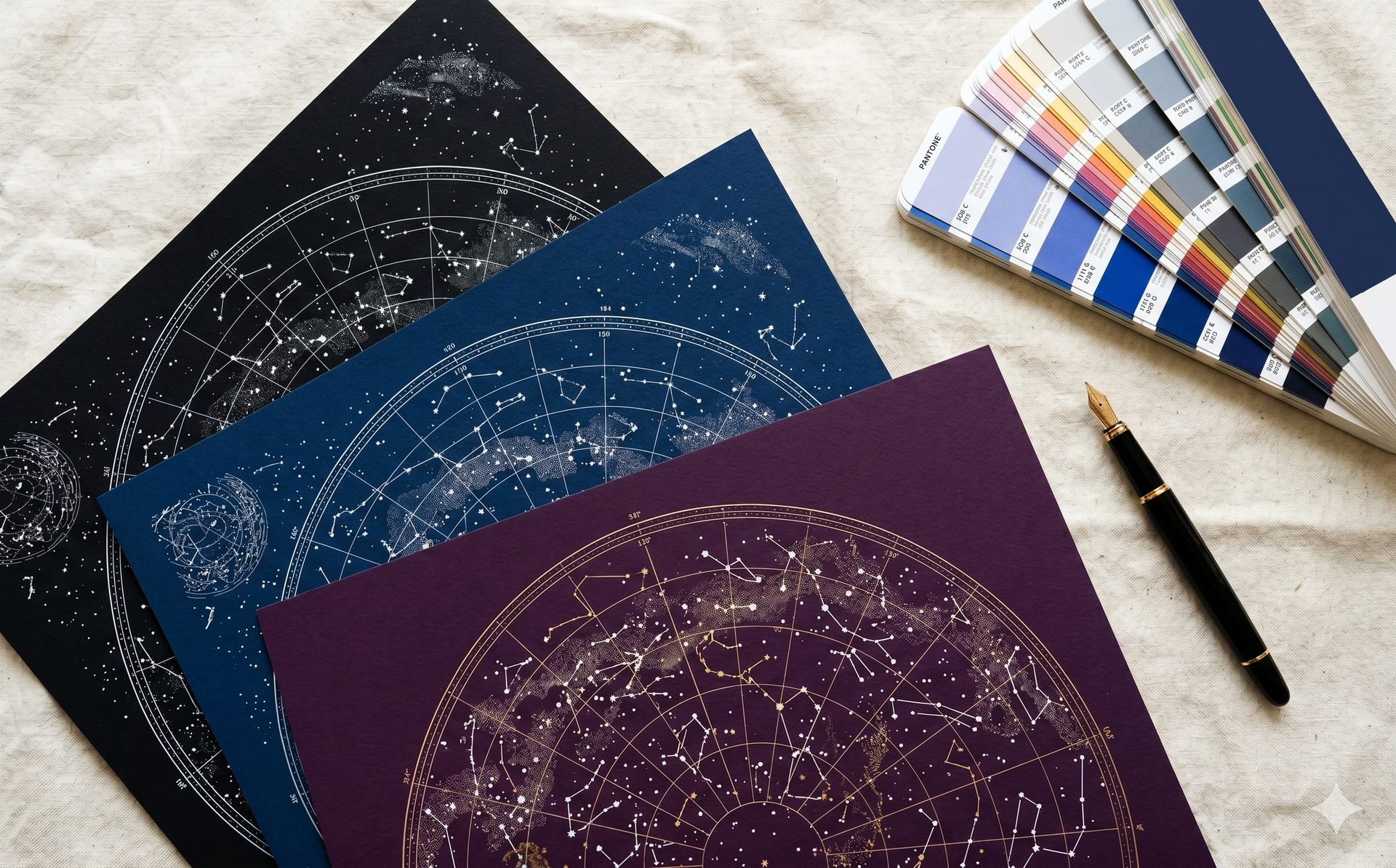
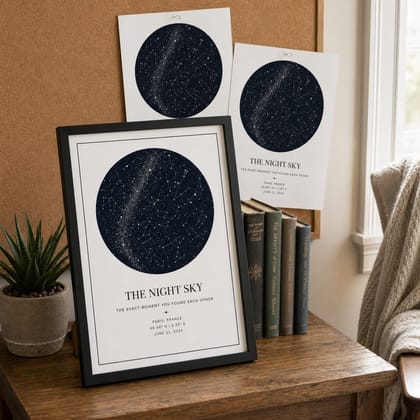
A flat lay of three custom star map posters in black, navy, and plum palettes beside a Pantone swatch book

The four decisions that actually matter

Most of the hundred-plus editor options don't matter — only four do. Nail these four and any remaining option is a stylistic preference the final poster doesn't live or die on.

The four: the shape of the sky window (circle, heart, arch, compass), the color palette (bg + text + stars), the typography pairing (one serif + one sans-serif), and the text you put on it (title, message, date).

Spend 80% of your design time on those four. Everything else — border width, frame color, inclusion of constellation labels — is a twenty-minute decision that won't move the needle.

Start with the shape, not the color

The shape of the sky window sets the emotional tone before any other choice. Circles read as classic and scientific. Hearts lean romantic and gift-y. Arches feel architectural, slower, more formal.

Pick the shape that matches the emotional register of the moment you're capturing. A first-child's birth night wants an arch. A 10-year wedding anniversary wants a circle or heart. An Apollo-launch commemorative wants a circle — period.

A compass shape reads as exploratory / travel-themed. It works well for city maps (paired with the city layout) and for couples with a wanderlust identity. It doesn't work as well for solemn commemorations where a circle or arch carries more gravitas.

If you can't decide, choose a circle. It's the default for a reason — it's the most neutral vessel for whatever meaning you're layering on top.

Three palettes that work for 90% of moments

Color is where most people overthink. You actually only need three palettes — every other option is a variation on these three.

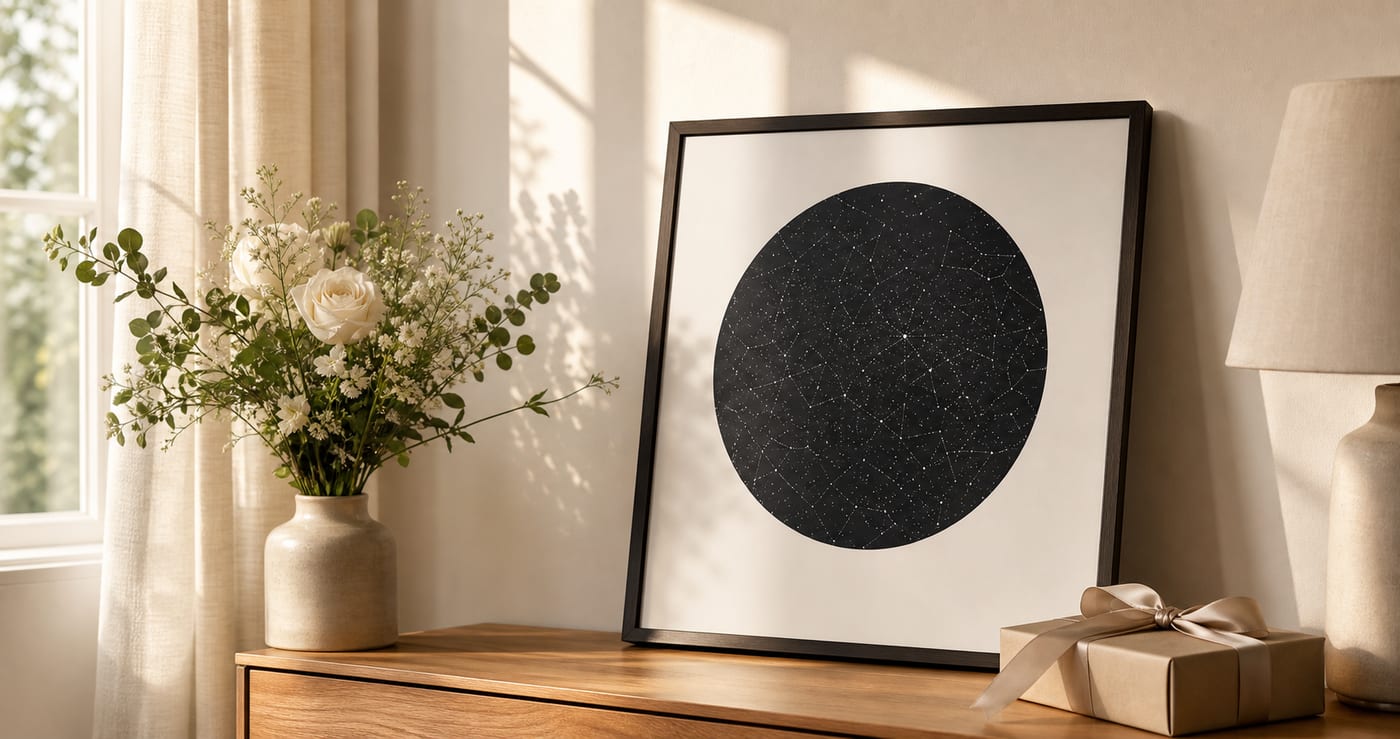
  1. Classic Black on White: Timeless, gallery-wall friendly, reads as editorial. Works for every occasion. Least likely to age.
  2. Deep Navy with Cream: The "stars in the night sky" instinct people reach for. Warm, nostalgic. Works for weddings and evening-moment commemoratives.
  3. Warm Plum with Gold: Anniversary / wedding palette. Romantic without tipping into saccharine. Best on heavyweight paper with a gold-foil finish.
Pick one of three, don't invent a fourth. Every custom palette we've seen at 5 years out looks dated.

Two-font rule: serif headline, sans-serif details

The #1 mistake first-time star-map designers make is mixing three or four fonts. Two is the cap, and one of them must be a serif — it's the emotional anchor.

Use a serif for the title — Cormorant Garamond, Playfair Display, and Great Vibes are our most-ordered options. Use a quiet sans-serif for the coordinates and date line beneath — Montserrat, Spectral, or Manrope work well.

Font size matters more than font choice. Make the title 2.5–3× the size of the date line. Weaker contrast reads as amateur even with great fonts.

Avoid decorative display fonts (Lobster, Pacifico, etc.). They clash with the celestial detail and age poorly — a Lobster-titled star map from 2018 screams 2018 today. Serifs don't.

Write text you'll still want to read in ten years

Inside jokes, pop-culture references, and nickname-heavy messages feel clever now but age badly on a wall. Every year, we get support emails asking if we can "reprint without the message" — almost always, the message was a meme or an inside reference.

Lean simple. "The sky on the night we said yes" works at year 1 and year 50. "OMG we did it!!" does not. "For the Queen of my heart, Gary" starts to cringe after year three.

A reliable formula: a short evocative phrase for the message, then the date line beneath. The restraint is the style.

If you want something more personal, write a short line in the voice of a narrator, not a participant: "The evening the rain finally stopped in Paris" rather than "I can't believe we're married!" — the latter feels dated instantly, the former ages like a photo caption.

Borders that don't fight the art

A single thin border frames the composition without shouting. A double border reads more formal and tends to work well on larger sizes (50×70cm and up).

Skip the border entirely if you're going to hang the poster in a physical frame — the frame itself becomes the border, and adding a drawn border on top creates a double-frame effect that fights the composition.

If you're printing unframed (e.g. for a digital download or a gift recipient who'll frame it themselves), a thin border reads more "finished" and helps the print sit cleanly inside whatever frame they choose.

Should you label the constellations?

Labeling the constellations is a niche preference that most customers should skip. Our data: 18% of orders enable constellation labels, and those are disproportionately astronomy enthusiasts, educators, and children's nursery gifts.

For wedding or anniversary posters, skip the labels. They clutter the composition and date the poster visually.

For educational contexts (children's rooms, gifts for students, science-loving partners), turn them on. Pair with the Modern palette and a slightly larger base size so the labels remain readable.

How to pick the right size

Size is driven by where the poster will hang, not by price. Measure the wall space first, then order to fit.

30×40cm fits above a bedside table, above a console table, or in a gallery-wall group. A3 is similar. Most customers' default.

50×70cm is a statement size — works above a sofa, above a headboard, or as a single-poster focal piece. Landscape-vs-portrait doesn't apply since star maps are always portrait.

70×100cm is a serious wall anchor. Works in larger living rooms, foyers, or above large dining tables. Don't order this size unless you've measured the wall — returning a 70×100cm print for size is logistically painful.

Six common mistakes to avoid

We've reviewed over 10,000 star-map orders. Six mistakes show up repeatedly.

  1. Typing the date without time. A wedding at 8pm vs. midnight shows different constellations. If the moment has a time, include it.
  2. Choosing a color based on your current bedroom palette. Rooms get repainted; the poster stays for decades.
  3. Using three fonts instead of two. Every extra font halves the design's age-well-ness.
  4. Putting a wedding hashtag on the poster. These always age out.
  5. Ordering a size without measuring the wall. 70×100cm is bigger than people expect.
  6. Not including a message at all. A blank caption feels unfinished — even a single date line is better than nothing.

よくある質問

What is the most popular star map design?

+

The classic circular black-on-white layout remains the best-seller (about 38% of Stars In Hands orders in 2025). It reads as editorial/gallery art rather than novelty, photographs well on walls, and matches any interior — from a gold-trim Victorian to a minimalist Scandinavian bedroom.

Should I include the exact time on my star map?

+

Include time whenever the time changes the sky meaningfully. A wedding at 8pm vs. midnight shows very different constellations. For baby birthdays, absolutely — include the birth time. For whole-day events (a generic birthday), you can leave time off and let the sky represent "that evening".

What fonts work best for star maps?

+

Cormorant Garamond and Playfair Display for romantic moments; Montserrat and Manrope for modern minimal layouts; Great Vibes for anniversaries and weddings; Cinzel for formal commemoratives. Avoid decorative display fonts like Lobster or Pacifico — they clash with the celestial detail and age poorly.

What color palette ages best on a star map?

+

Classic black-on-white (or deep navy on cream) ages best. Bright or on-trend palettes (millennial pink, rose gold, Gen-Z teal) look dated within 3-5 years. Neutral palettes never do. If you want color, use it as a single accent — gold title text, for example — against a neutral base.

Can I preview my star map design before ordering?

+

Yes — the Stars In Hands editor renders your exact sky in real-time as you adjust the date, location, and styling. What you see in the preview is pixel-for-pixel what will ship (minus any crop adjustments for different physical sizes).

What's the difference between shape options (circle, heart, arch)?

+

The shape sets the emotional register. Circle = classic and scientific (most neutral). Heart = romantic and gift-like (weddings, anniversaries). Arch = architectural and formal (births, memorials, formal commemoratives). Compass = exploratory (travel, city-coupled maps). Pick to match the feel of the moment, not just visual preference.

Should I order with or without a frame?

+

With a frame if it's a gift (eliminates assembly friction on gift day) or if you want a guaranteed fit. Without a frame if the recipient is particular about their interior palette or has a framer they prefer. Frames we ship are solid hardwood in black, walnut, or white — neutral enough to suit any room.

How long does a custom star map take to design?

+

With the date, time, and place in hand, a well-designed star map takes 5-10 minutes in the editor. Most of the time is spent fiddling with message text and font choices — the sky data is populated automatically from your chosen date and coordinates.

始めましょう

あなただけのスターマップを作成

日付・時間・場所を選ぶだけ。エディタで即座にプレビュー可能。80ドル以上のご注文で世界中送料無料。

デザインを始める