Education
Understanding Constellations: A Beginner's Guide to the Night Sky
The 12 most recognizable constellations, how they move across the sky, how to spot them from your backyard, and the astronomy behind the stories.

What a constellation actually is
A constellation is a human-drawn pattern superimposed on stars that appear close together on the sky. The stars themselves are usually nothing like close in space — they just happen to line up from Earth's angle.
Take Orion's belt as a classic example. Alnitak, Alnilam, and Mintaka look equally spaced and equally bright, but they're 700, 1,340, and 900 light-years from Earth respectively. They look like neighbors but are strangers.
Every culture drew different patterns on the same stars. The 88 constellations we use today are the International Astronomical Union's standard, finalized in 1922. Many trace back to Babylonian and Greek origins, but the official boundaries were only formally agreed on a century ago.
Constellations also define regions of sky, not just line patterns. Modern astronomers use them as address zones — "the supernova SN 1987A was in the Large Magellanic Cloud, located in the constellation Dorado" — a way of pointing to a piece of sky the same way latitude/longitude points to a piece of Earth.
Start with the Big Dipper — your north-sky anchor
If you can find only one pattern, make it the Big Dipper. It's in Ursa Major (the Great Bear), visible year-round in the Northern Hemisphere, and it's the anchor you'll use to find everything else.
Trace the two stars at the end of the cup upward — Merak and Dubhe, the "pointer stars" — and they point almost directly at Polaris, the North Star. Polaris sits above true north; it doesn't move.
From Polaris, you can orient the rest of the sky. The constellations on the opposite side of Polaris from the Big Dipper include Cassiopeia (the W-shaped queen) and Cepheus (her king). Below Polaris, toward the south, sit the seasonal constellations.
The Big Dipper itself isn't technically a constellation — it's an "asterism," a named pattern within the larger constellation of Ursa Major. But you'll rarely hear it called anything but the Dipper in casual conversation.
Four constellations, one per season
These are the highest-in-the-sky, easiest-to-find constellations for each season in the Northern Hemisphere. Aim to see one per season for a year and you'll have internalized the rhythm of the sky.
- Winter — Orion: Three bright belt stars; impossible to miss. Visible November–March evenings. Contains the Orion Nebula, one of few deep-sky objects visible to the naked eye.
- Spring — Leo: The backward question mark (called the "Sickle") forms the lion's head. April–June. Home of Regulus, the 21st-brightest star in the sky.
- Summer — Cygnus: The northern cross, flying along the Milky Way. July–September. Contains Deneb, one of the three stars in the Summer Triangle asterism.
- Autumn — Pegasus: The Great Square — four stars forming an almost-perfect square. October–December. The trailhead into Andromeda, our galactic neighbor.
The zodiac — 12 constellations the sun passes through
The 12 zodiac constellations — Aries, Taurus, Gemini, Cancer, Leo, Virgo, Libra, Scorpius, Sagittarius, Capricornus, Aquarius, and Pisces — are the ones the sun appears to traverse over the course of a year.
Because the sun is in front of these, they're only visible at night during the opposite half of the year. Your "sun sign" constellation isn't visible at night during your birthday — it's washed out by the sun.
There's actually a 13th constellation the sun passes through — Ophiuchus, the serpent-bearer — but it was dropped from the zodiac because 13 didn't divide neatly into the 12-month calendar. Ancient Babylonian priests preferred arithmetic tidiness over astronomical accuracy.
The zodiac lies along the ecliptic — the plane of Earth's orbit around the sun. That same plane is roughly where the moon and planets also travel, which is why planetary alignments always appear within the zodiac band rather than scattered across the whole sky.
The 10 brightest stars (and how to find them)
Brightness in astronomy is measured on an inverted scale — smaller numbers mean brighter. The brightest star (Sirius) has magnitude −1.46; the dimmest stars the naked eye can see are about magnitude 6.
- Sirius (−1.46): The Dog Star, in Canis Major. Brightest in the sky. Winter.
- Canopus (−0.74): Visible mainly in the Southern Hemisphere.
- Alpha Centauri (−0.27): The closest star system to our own. Southern.
- Arcturus (−0.05): In Boötes. Spring and summer. Follow the arc of the Big Dipper's handle.
- Vega (+0.03): In Lyra. Summer. Part of the Summer Triangle.
- Capella (+0.08): In Auriga. Winter. High in the northern sky.
- Rigel (+0.13): In Orion, at the hunter's foot. Winter.
- Procyon (+0.37): In Canis Minor. Winter.
- Betelgeuse (+0.45): Orion's shoulder. Distinctly red-orange.
- Altair (+0.77): In Aquila. Summer. Third vertex of the Summer Triangle.
How to actually start stargazing tonight
You don't need a telescope. You need a dark-ish spot, a phone app, and 20 minutes for your eyes to adapt.
The best free phone apps for constellation ID are Stellarium Mobile and SkyView Lite. Both use your phone's orientation sensors to overlay constellation names on the actual sky when you point the camera up.
Dark adaptation takes 15–20 minutes of no bright light. Even a glance at a phone screen resets it. Use the app briefly, then put the phone away and let your eyes re-adapt.
Once you can pick out Orion, the Big Dipper, Cygnus, and Cassiopeia by eye (without the app), you have enough reference points to learn the rest without looking anything up. That usually happens around your fifth or sixth stargazing session.
The stars you can see tonight are the same ones the ancient Greeks saw 2,500 years ago. That's part of the magic.
Northern vs. Southern Hemisphere — different skies
The Northern and Southern Hemispheres see largely different skies, with about 30% overlap near the celestial equator. The Big Dipper, Polaris, and Cassiopeia are Northern staples. The Southern Cross, Crux, and Alpha Centauri are Southern staples.
If you travel between hemispheres, the sky you grew up with isn't there anymore. That unsettles a lot of first-time travelers more than it should — the night sky is more place-specific than most of the environment.
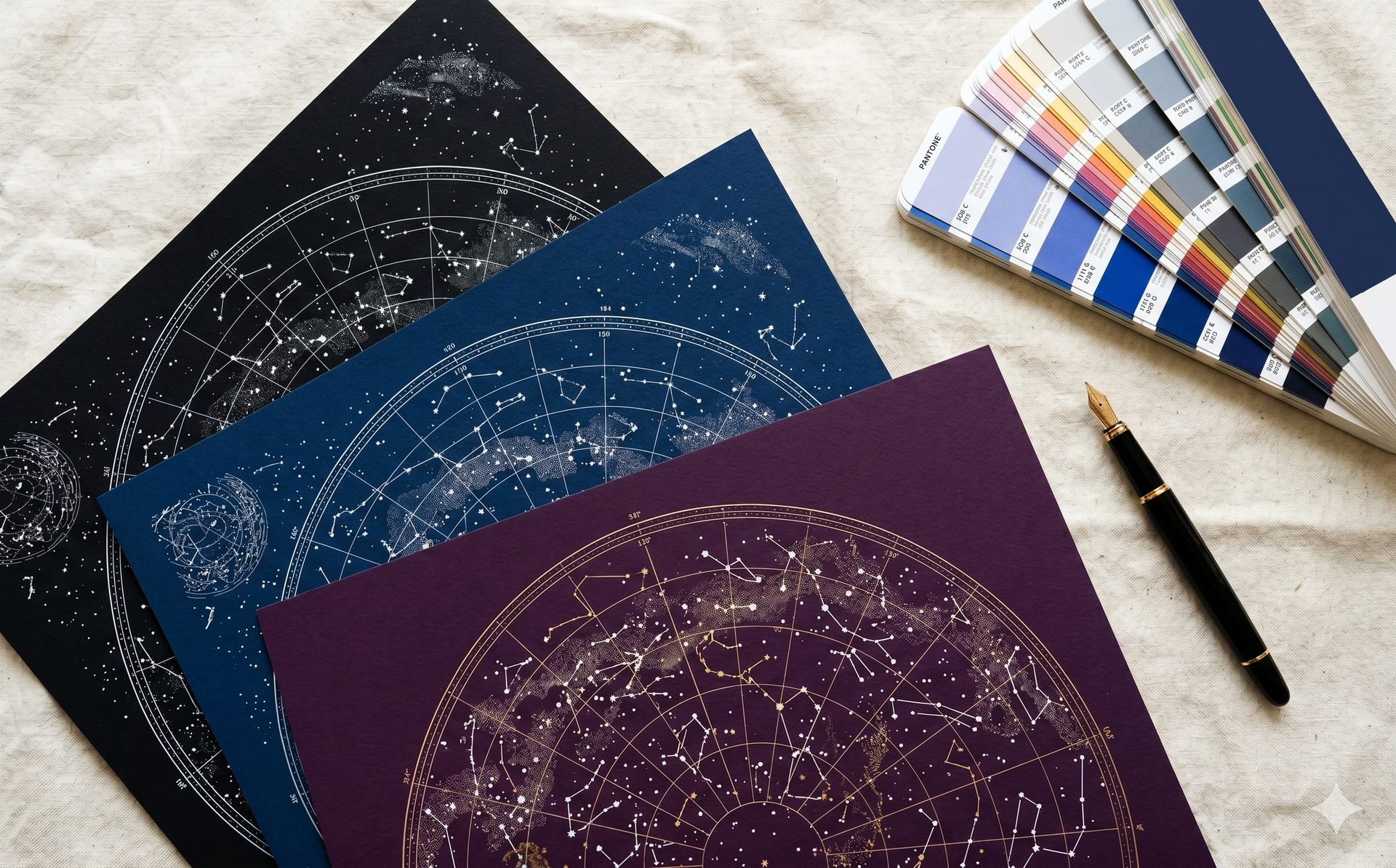
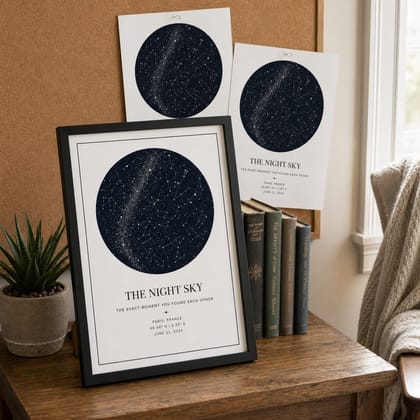
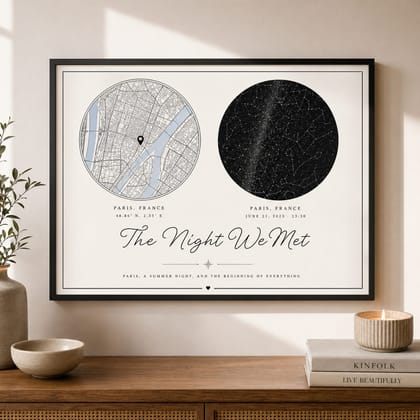
A Stars In Hands star map of your birthplace will show your local sky — so traveling to the other hemisphere and hanging a map of home is a way of keeping both skies available to you at once.
Naked-eye deep-sky objects to check off
Most "galaxies and nebulae" require a telescope, but a few are visible to the naked eye under decent conditions. Finding them is a stargazer's rite of passage.
- The Andromeda Galaxy (M31): The farthest thing the human eye can see unaided, at 2.5 million light-years. In Andromeda; autumn.
- The Orion Nebula (M42): A stellar nursery in Orion's sword. Fuzzy to the naked eye; winter.
- The Pleiades (M45): A tight cluster of seven bright young stars in Taurus. Winter.
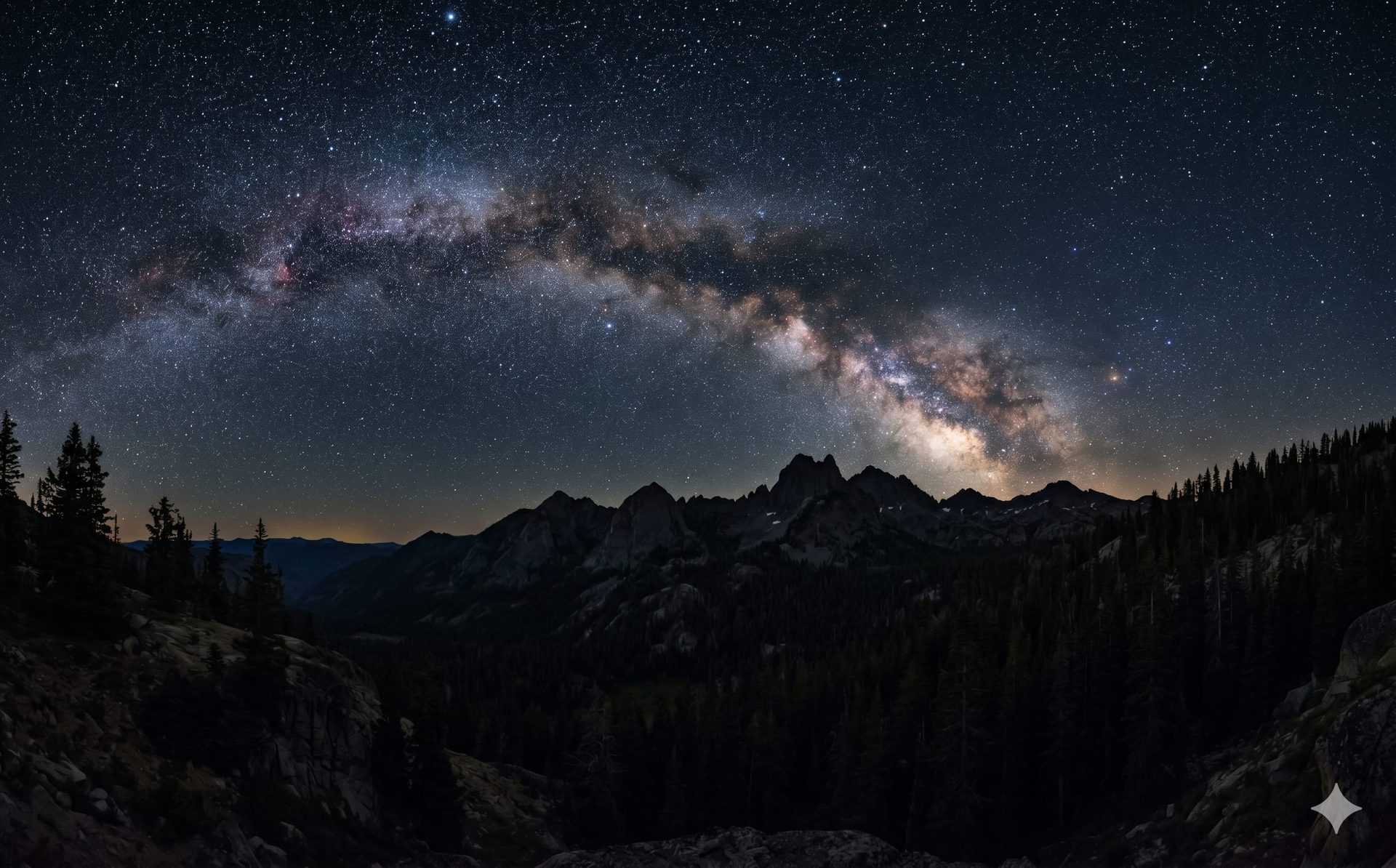
- The Milky Way band: Our own galaxy edge-on. Visible in summer (looking toward the galactic center) and winter (looking away).
- The Large and Small Magellanic Clouds: Two of our nearest galactic neighbors. Southern-hemisphere only.
Perguntas frequentes
How many constellations are there?
+
The International Astronomical Union recognizes 88 official constellations. Of those, about 48 are visible from the Northern Hemisphere and about 48 from the Southern — with overlap at the equator. The constellations were formally standardized in 1922.
Are zodiac constellations real?
+
The constellations themselves are real patterns of stars. The astrological meanings assigned to them aren't scientifically supported, but the 12 zodiac constellations are genuine star groupings the sun passes in front of during the year. There's actually a 13th constellation on the ecliptic (Ophiuchus), dropped from the zodiac because 13 didn't divide neatly into the 12-month calendar.
Why can't I see my zodiac sign on my birthday?
+
Your sun-sign constellation sits behind the sun on your birthday, so it's in the daytime sky — invisible to you. You can see it at night six months later, when Earth has orbited to the opposite side of the sun.
How do I start stargazing without a telescope?
+
Find a dark-ish spot, install Stellarium Mobile or SkyView Lite on your phone, and allow 15-20 minutes for your eyes to dark-adapt. Use the app briefly to identify the Big Dipper and Orion (depending on season), then put the phone away and let your vision adjust. Most beginners can identify four major constellations unaided within five sessions.
What's the brightest star in the night sky?
+
Sirius, also called the Dog Star, in the constellation Canis Major. Its apparent magnitude is −1.46, about twice as bright as the next-brightest star, Canopus. Sirius is best visible in the Northern Hemisphere during winter evenings.
What is the Milky Way band?
+
It's the visible edge of our galaxy — the Milky Way seen from inside it. Billions of stars too faint to resolve individually blur into a pale band stretching across the sky. It's visible from dark locations year-round, but best in summer (toward the galactic center in Sagittarius/Scorpius) and winter (looking toward the galactic anti-center in Taurus/Auriga).
Do the constellations on Stars In Hands maps match what I'd see in real life?
+
Yes — we use the official IAU constellation lines rendered from the Hipparcos star catalog. What appears on your map is exactly what an astronomer would draw for the same date, time, and location. If you held the poster up under clear skies on the correct night at the correct place, the constellations would align.
What's the difference between Northern and Southern Hemisphere skies?
+
The Northern and Southern Hemispheres see mostly different skies, with about 30% overlap near the celestial equator. Northern staples include the Big Dipper, Polaris, and Cassiopeia. Southern staples include the Southern Cross (Crux) and Alpha Centauri. If you travel between hemispheres, the sky you grew up with isn't there anymore — which unsettles many first-time travelers.
Pronto para começar?
Crie o seu próprio mapa estelar
Escolha data, hora e local. Pré-visualização instantânea no editor. Envio gratuito para todo o mundo em encomendas acima de 80 $.
Começar a criar